The Thread Clocking Problem
A two-prong detector has one more variable, unrelated to the condition of its magnet. The detector threads into its port, so the angle of the prongs to the oil flow depends on where the threads stop and the lockwire aligns. One installation may have the rods one behind the other, in line with the flow. Another, on an identical gearbox, may have them side by side, across the flow. This angle is not chosen, and it is rarely recorded.
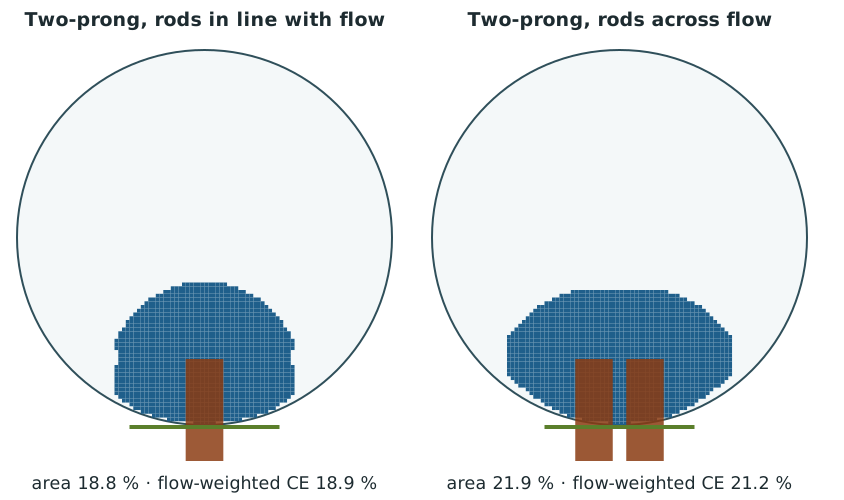 The same two-prong detector in two installed orientations, viewed looking downstream. Left: rods in line with the flow, one behind the other. Right: rods across the flow, side by side. Every 250 µm chip released inside the blue area is caught. KasperAero analysis, not test data.
We ran the rotation through the same pipe model, from 0° (in line) to 90° (across). The detector was placed on the side and on the bottom of the pipe, and also run with gravity off to isolate the magnet.
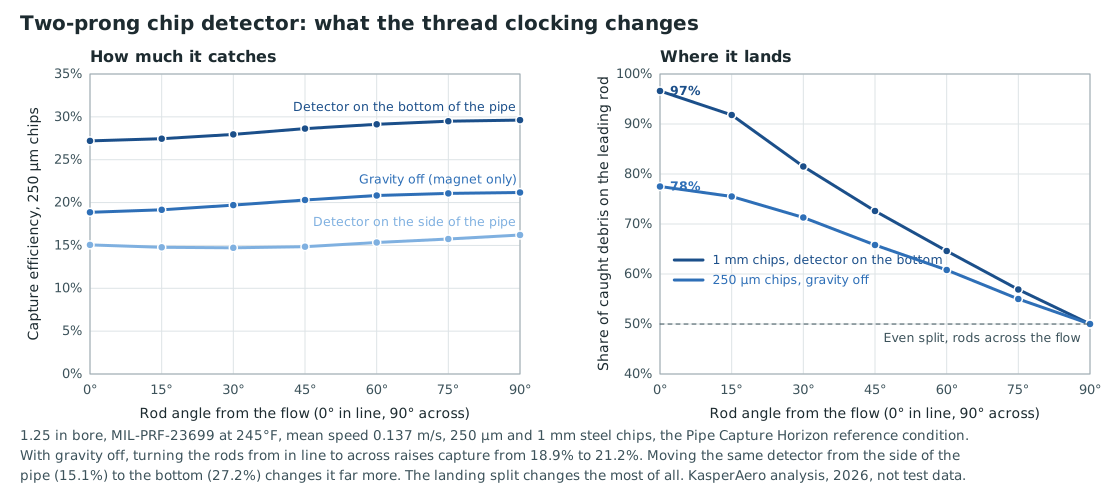 Left: capture rises slightly as the rods turn across the flow. The detector's position on the pipe has a larger effect. Right: the landing location changes substantially. With the rods in line, the leading rod collects most of the debris. KasperAero analysis, not test data.
The effect on capture is modest. With gravity off, turning the rods from in line to across raises capture from 18.9% to 21.2%. The port position has a larger effect. The same detector captures 15.1% on the side of the pipe, 27.2% on the bottom and about 7% on the top.
The effect on landing location is much larger. With the rods in line with the flow, the leading rod collects 78% of the captured 250 µm debris. With the detector on the bottom of the pipe, it collects 97% of the 1 mm chips. The trailing rod is shielded and collects almost nothing. With the rods across the flow, the split is even.
This matters because a two-prong detector indicates only when debris bridges the gap between the rods. Our field analysis shows that chips already favor the outer corners of the prongs over the gap. Independent laboratory testing found that the gap of a production two-prong detector bridged in only 10 of 36 runs. When nearly all of the debris collects on one rod, a bridge is even less likely. Two identical detectors in identical gearboxes, wearing at the same rate, can give different indications because of how far the threads turned.
Debris on production two-prong chip detectors in independent laboratory capture testing. Left: chips standing up on the two pole faces. Right: chips gathered on the tips and outer edges of the rods while the gap between them stays open. The detectors were bought on the open market for this testing.